
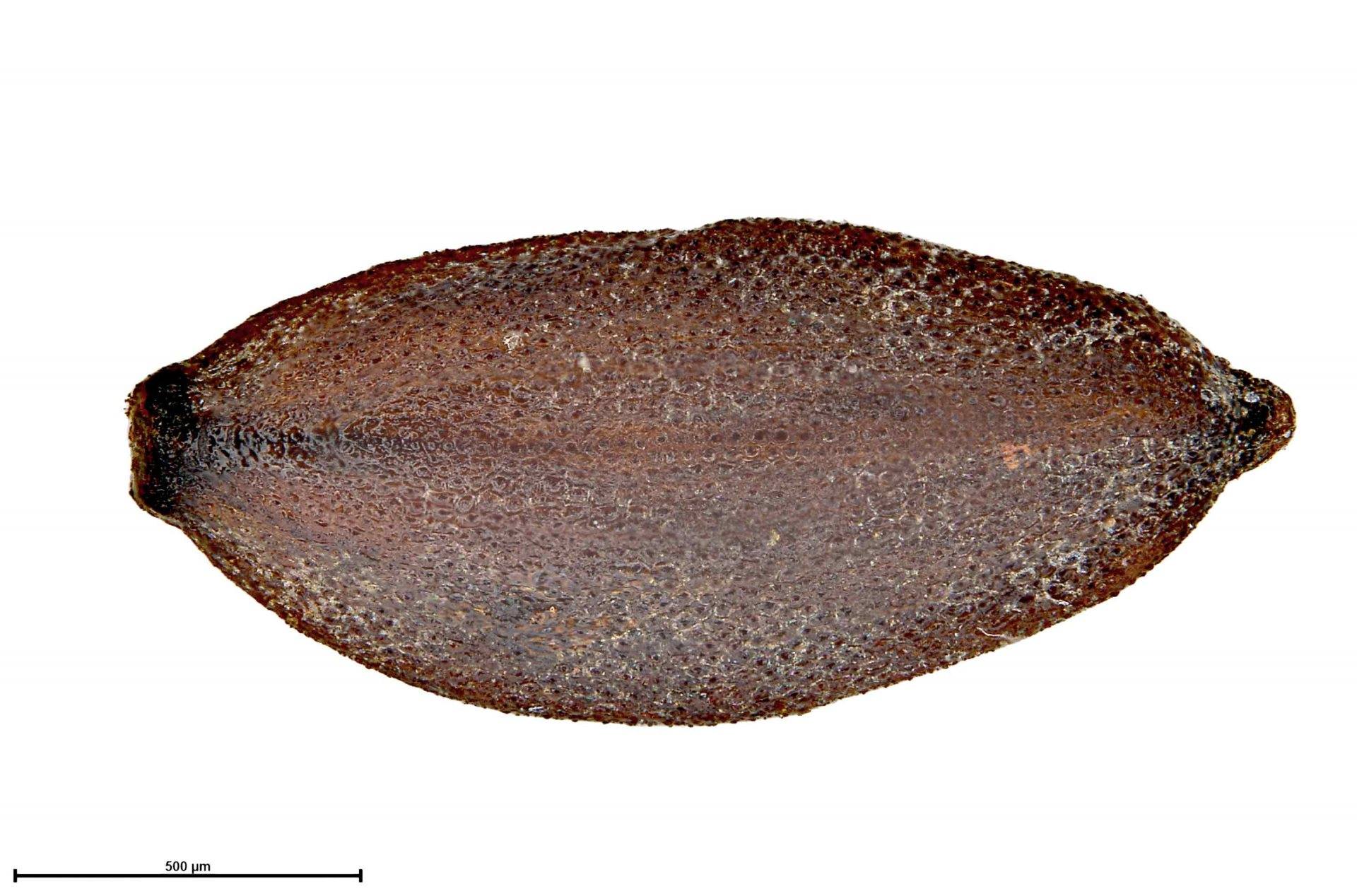

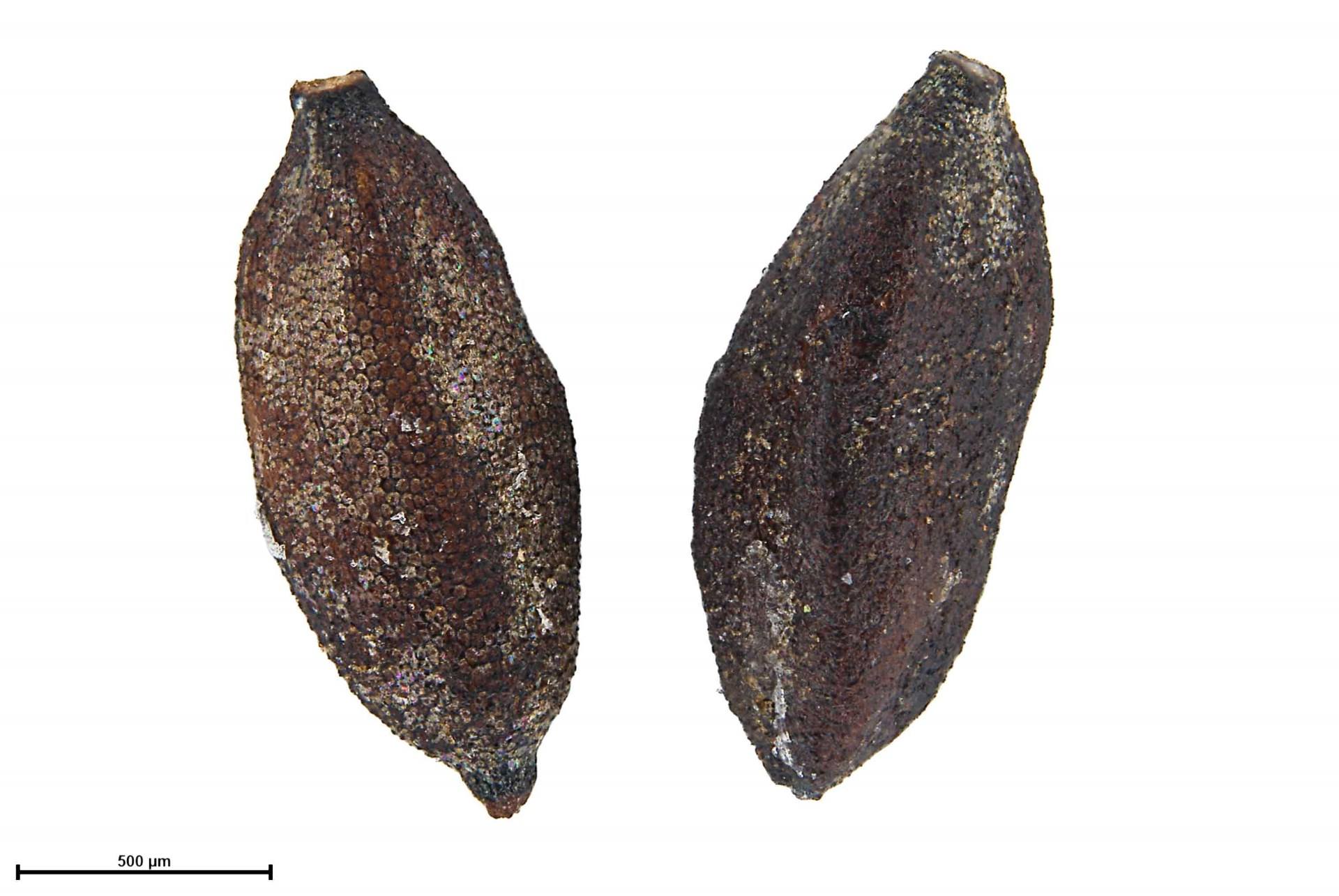
Cyperus hillebrandii var. hillebrandii is a perennial species distinguished by its short, sometimes slightly thickened rhizomes adorned with brown or reddish-brown basal sheaths and their fibrous remnants. The culms of this plant can reach a height of 15–60(–90) cm and are 2–6 mm in diameter near the base, featuring a trigonous and smooth texture. The leaves are simple and linear, with a stiffness that can vary in length, either shorter than or exceeding the culm, and are 3–12 mm wide. The lower sheaths of the leaves may exhibit a reddish-brown hue, and like many in its family, it lacks stipules. Floral characteristics include umbelliform inflorescences that are either simple or compound, appearing dense to lax, spanning 2–5 cm in length and 3–12 cm in width. The inflorescence comprises 6–8 rays, each 1–4 cm long, with solitary spikes accompanied by 1–3 lateral spikes. These spikes are cylindrical to oblong-cylindrical, 2–4 cm long, and 8–10 mm wide, densely populated with numerous spikelets. Involucral bracts number between 4–8, with the lower ones surpassing the length of the inflorescence, sometimes reaching up to 15 cm in length. The spikelets, bearing 6–8 flowers each, display a pale to darker reddish-brown coloration and are tightly imbricate. The fruit is an oblong-ellipsoid, trigonous achene, measuring 1.4–1.7 mm in length and 0.5–0.7 mm in width. It produces a single seed with a thin coat, distinct from the pericarp, with an embryo at the base surrounded by abundant endosperm. It occurs in diverse habitats ranging from ridges and ‘a’a lava landscapes to gulches and forests of varying moisture levels, extending into subalpine zones. Its elevation range spans from (60–)250-1980 meters.
Bean-shaped (Reniform): Resembling the shape of a kidney or bean.
Square or Oblong: Angular shape with all sides more or less equal or longer than wide.
Triangular: Three-sided shape, broadest below the middle.
Elliptic: Rounded at both ends. shaped like an ellipse or oval.
Ovate or Obovate: egg-shaped, broader at one end.
Linear: Extremely long and narrow, with sides usually parallel.
Round: Appears circular, with length and width roughly the same.
Cardioid (Heart-Shaped): One edge has a prominent double curve into two lobes.
Cylindrical: A cylinder with parallel sides and a circular cross-section.
Discoid: Resembling a disc or plate with two relatively flat surfaces.
Fusiform: Spindle-shaped, tapering at both ends.
Globose: Spherical.
Lenticular: Resembling a lens with two convex surfaces.
Ovoid: Egg-shaped.
Plano-convex: Having a flat ventral (planar) surface and a curved dorsal (convex) surface.
Polygonal: Having more than three flat faces meeting at angles.
Sectoroid: Resembling a segment of an orange with two relatively flat faces and one curved face.
Subglobose/ellipsoid: Inflated shape but less than spherical.
Trigonous: Having three faces that meet at a distinct angle; triangular in cross-section.
Endangered species (E) are species that are so rare they’re in danger of becoming extinct.
Threatened species (T) are species that are likely to become endangered within the foreseeable future throughout all or a significant portion of their range.
Species of Concern (SOC) are species about which there are some concerns regarding status and threats, but insufficient information is available to list the species under the Endangered Species Act (ESA).
Plant Extinction Prevention (PEP) is a state status for rare plants that focuses its efforts on species that have fewer than 50 remaining wild individuals.
Orthodox seeds (desiccation-tolerant): can be dried to an internal seed moisture of less than 12% water and stored at freezing temperatures.
Intermediate seeds (temperature-sensitive) tend to age faster than orthodox seeds and may have only a 5-year lifespan when stored at -20°C. They are recommended for storage at 5°C.
Recalcitrant seeds (desiccation-sensitive): cannot be stored in a conventional freezer as they cannot survive after drying and/or freezing at -20°C. They are recommended for cryopreservation storage.