


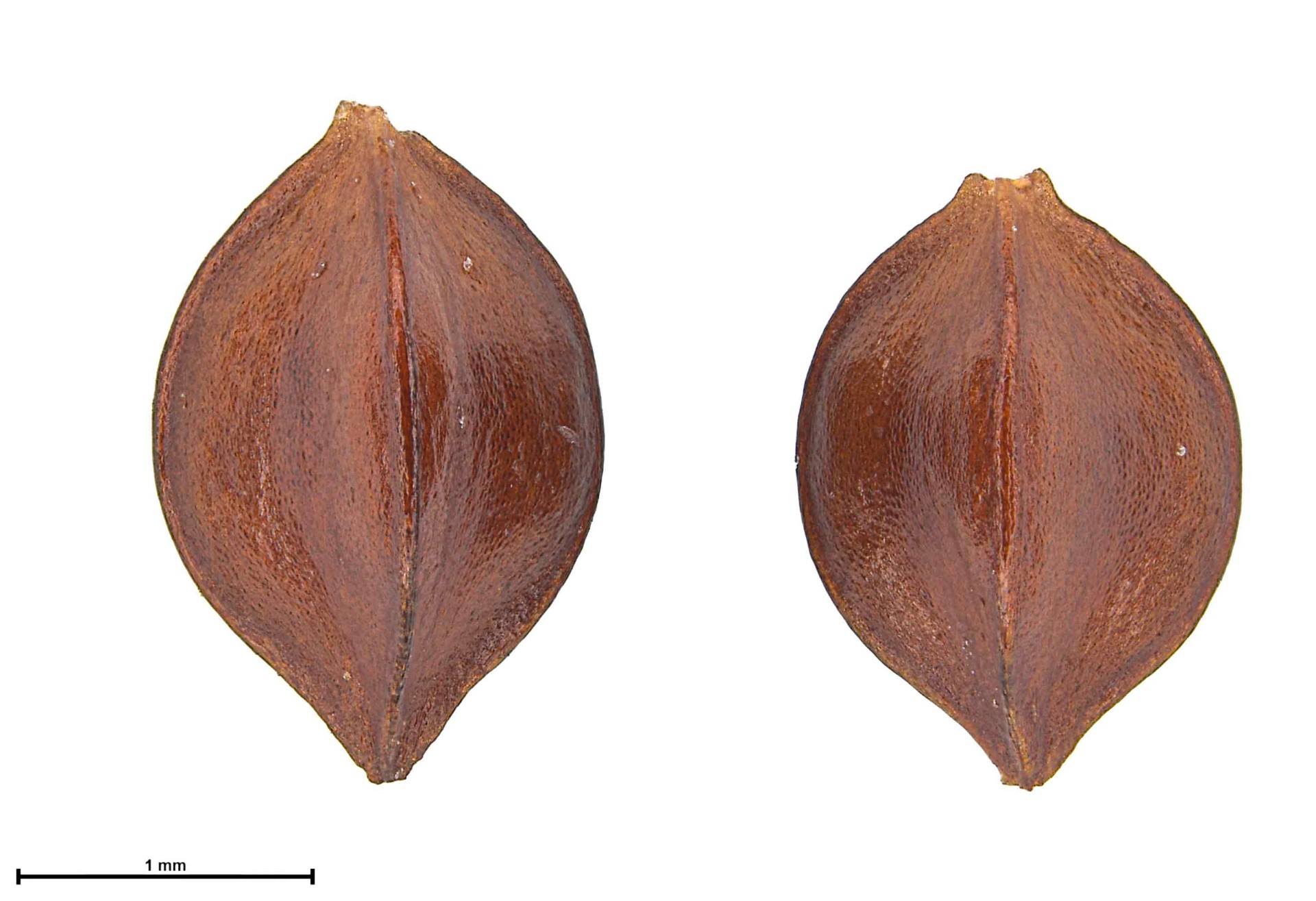
Rumex skottsbergii is a shrub characterized by usually stiffly erect stems that are 70 to 100 cm long and glabrous. It has a taproot system. The leaves of this shrub are simple and alternate, with flat, ovate to oblong-ovate or oblong-elliptic blades measuring 5.5 to 13.5 cm in length and 1.4 to 5.8 cm in width. The leaf apex is acute to obtuse, and the base is broadly cuneate. The surfaces of the leaves are glabrous, thick, and somewhat glossy, with entire and flat margins. The petioles are 1.7 to 5 cm long, and the stipules form a sheath or ocrea. The numerous flowers are found in small to medium-sized, green or yellowish-green, somewhat congested, many-branched, usually erect, paniculate inflorescences measuring 10 to 20 cm long and 5 to 15 cm wide. It is monoecious with unisexual flowers, with the proportions of each sex varying. The tepals are in sets of six, with the outer three being much smaller than the inner ones, and connate at the base into a minute floral tube. The staminate flowers have about 1 mm long outer tepals, with the valves being membranous and greenish. The pistillate flowers have greenish outer tepals, approximately 1 to 1.5 mm long, enlarging to 5.5 to 6.2 mm in fruit and becoming cordate with conspicuous venation and denticulate margins. There are six stamens with dithecal anthers that open longitudinally. The superior ovary is 1-celled with one ovule, three styles, and fimbriate, dry stigmas. The fruit is a pale brown trigonous nut enclosed by the valves, about 1.8 to 2 mm long, with two sides of a single arm of a mature nut distinctly diverging at about a 45° angle. The seeds contain well-developed, starchy, and oily endosperm. It inhabits dry ʻaʻā and pāhoehoe lava, and possibly ash between 460-1,300 meters.
Bean-shaped (Reniform): Resembling the shape of a kidney or bean.
Square or Oblong: Angular shape with all sides more or less equal or longer than wide.
Triangular: Three-sided shape, broadest below the middle.
Elliptic: Rounded at both ends. shaped like an ellipse or oval.
Ovate or Obovate: egg-shaped, broader at one end.
Linear: Extremely long and narrow, with sides usually parallel.
Round: Appears circular, with length and width roughly the same.
Cardioid (Heart-Shaped): One edge has a prominent double curve into two lobes.
Cylindrical: A cylinder with parallel sides and a circular cross-section.
Discoid: Resembling a disc or plate with two relatively flat surfaces.
Fusiform: Spindle-shaped, tapering at both ends.
Globose: Spherical.
Lenticular: Resembling a lens with two convex surfaces.
Ovoid: Egg-shaped.
Plano-convex: Having a flat ventral (planar) surface and a curved dorsal (convex) surface.
Polygonal: Having more than three flat faces meeting at angles.
Sectoroid: Resembling a segment of an orange with two relatively flat faces and one curved face.
Subglobose/ellipsoid: Inflated shape but less than spherical.
Trigonous: Having three faces that meet at a distinct angle; triangular in cross-section.
Endangered species (E) are species that are so rare they’re in danger of becoming extinct.
Threatened species (T) are species that are likely to become endangered within the foreseeable future throughout all or a significant portion of their range.
Species of Concern (SOC) are species about which there are some concerns regarding status and threats, but insufficient information is available to list the species under the Endangered Species Act (ESA).
Plant Extinction Prevention (PEP) is a state status for rare plants that focuses its efforts on species that have fewer than 50 remaining wild individuals.
Orthodox seeds (desiccation-tolerant): can be dried to an internal seed moisture of less than 12% water and stored at freezing temperatures.
Intermediate seeds (temperature-sensitive) tend to age faster than orthodox seeds and may have only a 5-year lifespan when stored at -20°C. They are recommended for storage at 5°C.
Recalcitrant seeds (desiccation-sensitive): cannot be stored in a conventional freezer as they cannot survive after drying and/or freezing at -20°C. They are recommended for cryopreservation storage.