
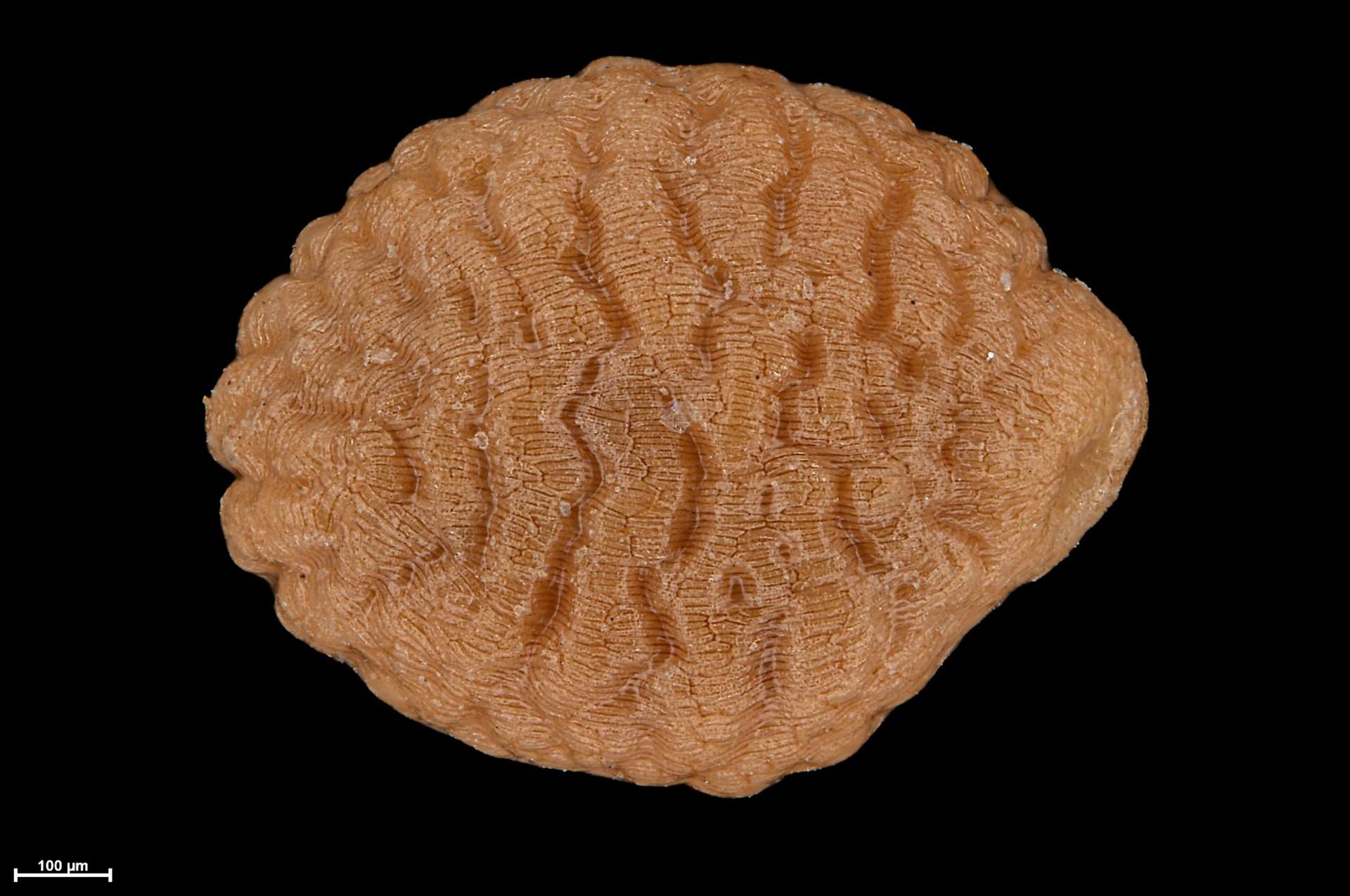
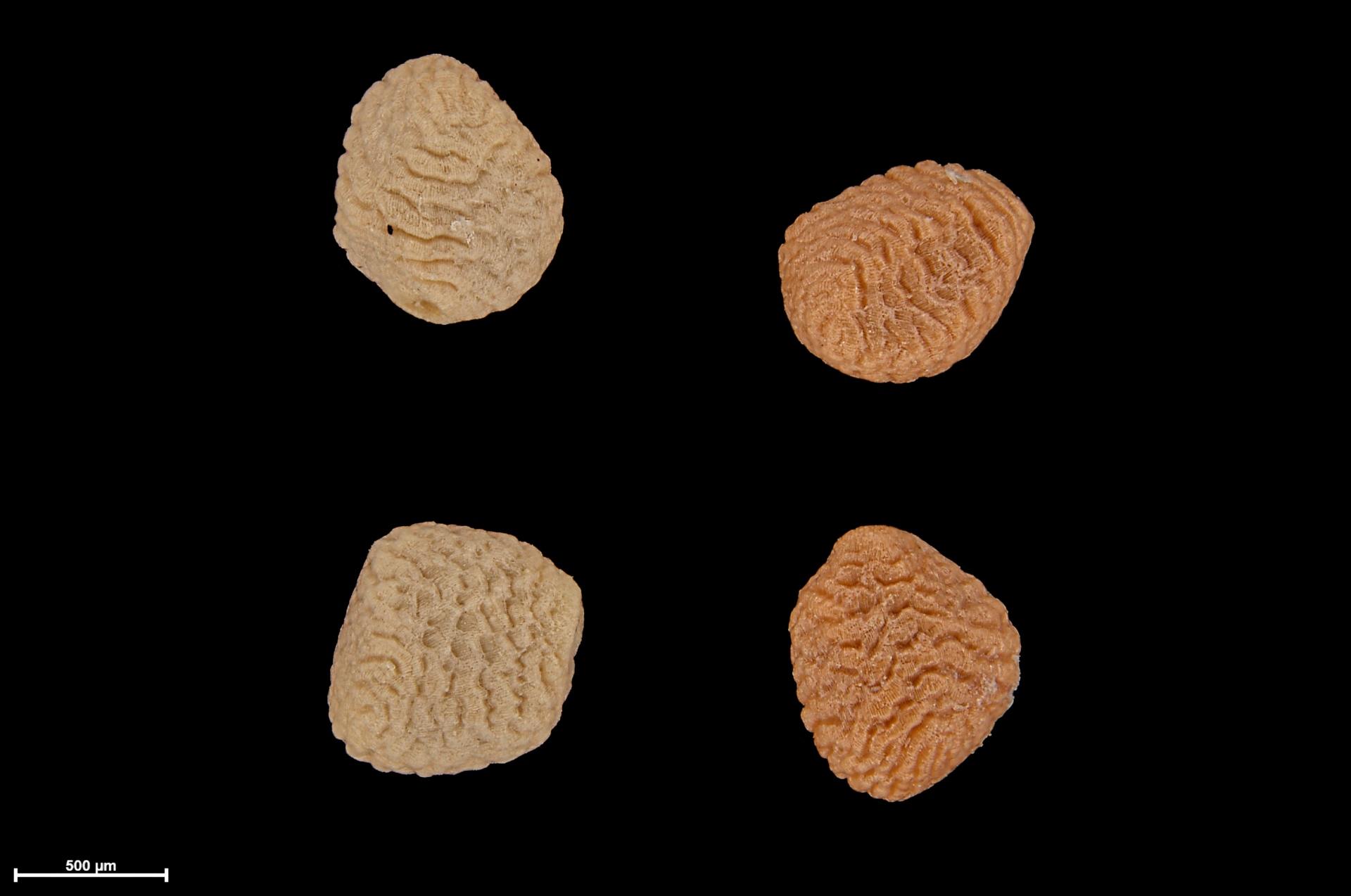
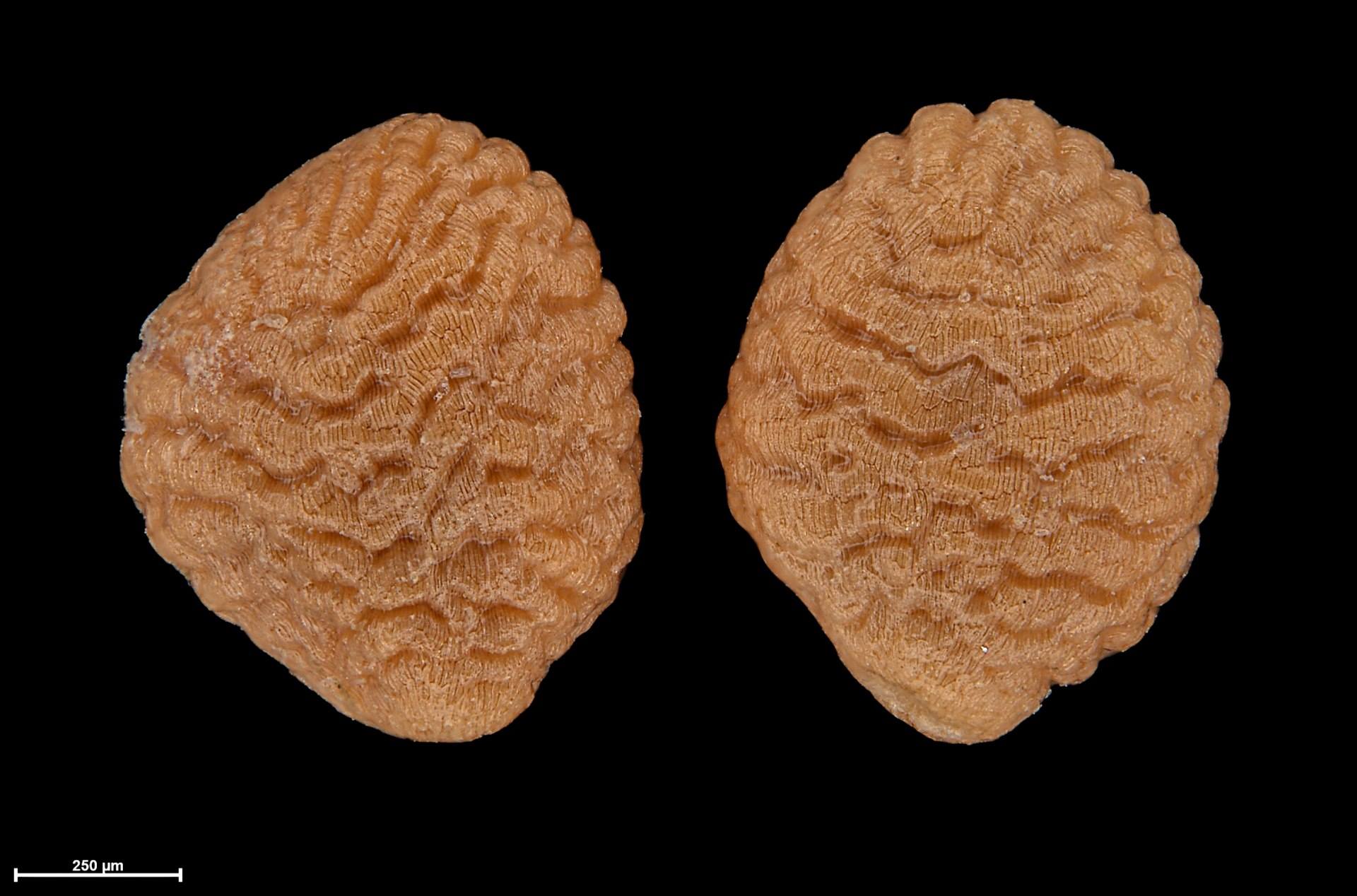
Delissea rhytidosperma is a shrub growing 0.5–2.5 meters tall. The stems are usually branched, erect, or ascending, measuring 4–12 mm in diameter, and are light gray or brown, unarmed, and glabrous, with numerous helically arranged leaf scars toward the apex. The plant is moderately leafy toward the apex and exudes white, viscous latex. The leaves are simple, alternate, well-dispersed on the distal stem, or congested into apical rosettes. The blades are oblanceolate, elliptic, or narrowly elliptic, 8–19 cm long and 2.0–5.5 cm wide, with an acute or acuminate apex and a cuneate or attenuate base. The margins are serrulate or crenulate, and the leaves are pinnately veined. The petioles are terete (cylindrical), 2.0–6.5 cm long, and 1/4–1/2 as long as the lamina. Stipules are absent. The flowers are in inflorescences, several per stem, axillary, racemose, and racemes are 5–20-flowered. The peduncle and rachis are ascending or spreading and glabrous, with the peduncle measuring 3–20 mm long and the rachis 5–30 mm long. The bracts are 0.8–2.7 mm long, triangular or deltate (rarely becoming larger, foliaceous, oblanceolate), and glabrous, persistent, each subtending a pedicel. The pedicels are 8–13 mm long, ascending or spreading, ebracteolate, or with a pair of minute knob-like glabrous or commonly pubescent bracteoles at or above the base. The hypanthium is 4–6 mm long and 3.5–4.5 mm in diameter, broadly ellipsoid or obovoid, and about 1/6 as long as the corolla. The flowers are tetracyclic, bisexual (perfect), complete, protandrous, epigynous, and resupinate. The calyx is synsepalous and actinomorphic (radially symmetric), with a tube adnate to the ovary, forming a glabrous hypanthium 1/10–1/3 as long as the corolla. The calyx lobes are 5, 0.5–1.0 mm long, 0.5–0.7 mm wide, glabrous, persistent, distinct, and triangular or deltate. The corolla is sympetalous, zygomorphic (bilaterally symmetric), bilabiate, glabrous, greenish, and 14-24 mm long. The tube is gently curved, laterally compressed, 10-14 mm long, 1.5-2.0 mm tall at the base, 2.0-4.2 mm tall above the middle, dorsally cleft to about the middle, with a single small knob at the terminus of the cleft. The lobes are 5, linear triangular, valvate, spreading, acute or acuminate at the apex, with the dorsal lobes 4-11 mm long, 0.8-1.5 mm wide, and the ventral lobes 7-10 mm long, 1.0-1.5 mm wide, usually connate for 1/4–1/2 their length. The stamens are 5, syngenesious, antisepalous, and exserted, emerging from the corolla above (rarely between) the dorsal lobes. The filaments are connate, free from the corolla, and inserted on the rim of the hypanthium. The filament tube is 12–20 mm long, and the anther tube is 1.7–1.9 mm in diameter, short–pubescent at the base, glabrous or sparsely pubescent. The anthers are connate, dithecal, dehiscing introrsely and longitudinally, with the dorsal anthers 4.5–5.0 mm long, 1/4–3/10 as long as the filament tube, occluding the orifice of the tube, and the ventral anthers 3.5–4.0 mm long, with tufts of hairs 1.0–1.5 mm long at the apex. The pollen is tricolporate, prolate, and ellipsoidal. The ovary is inferior, 2-loculed, crowned by an annular nectary, with axile placentation and numerous ovules. The style is slender, terete (cylindrical), with a ring of stiff white hairs near the apex. The stigma is 2-lobed, with the lobes appressed and non-receptive as the style grows through the anther tube, pushing out pollen, after which the stigmas spread and become receptive. The fruit is a small purple fleshy, thin-walled berry, 5–12 mm long and 5–11 mm in diameter, globose or ellipsoid. The seeds are numerous, 0.8–1 mm long, 0.6–0.8 mm wide, grayish white, ellipsoid, compressed, dull, and transversely rugose. It is found in mesic forest at 260 – 915 meters.
Bean-shaped (Reniform): Resembling the shape of a kidney or bean.
Square or Oblong: Angular shape with all sides more or less equal or longer than wide.
Triangular: Three-sided shape, broadest below the middle.
Elliptic: Rounded at both ends. shaped like an ellipse or oval.
Ovate or Obovate: egg-shaped, broader at one end.
Linear: Extremely long and narrow, with sides usually parallel.
Round: Appears circular, with length and width roughly the same.
Cardioid (Heart-Shaped): One edge has a prominent double curve into two lobes.
Cylindrical: A cylinder with parallel sides and a circular cross-section.
Discoid: Resembling a disc or plate with two relatively flat surfaces.
Fusiform: Spindle-shaped, tapering at both ends.
Globose: Spherical.
Lenticular: Resembling a lens with two convex surfaces.
Ovoid: Egg-shaped.
Plano-convex: Having a flat ventral (planar) surface and a curved dorsal (convex) surface.
Polygonal: Having more than three flat faces meeting at angles.
Sectoroid: Resembling a segment of an orange with two relatively flat faces and one curved face.
Subglobose/ellipsoid: Inflated shape but less than spherical.
Trigonous: Having three faces that meet at a distinct angle; triangular in cross-section.
Endangered species (E) are species that are so rare they’re in danger of becoming extinct.
Threatened species (T) are species that are likely to become endangered within the foreseeable future throughout all or a significant portion of their range.
Species of Concern (SOC) are species about which there are some concerns regarding status and threats, but insufficient information is available to list the species under the Endangered Species Act (ESA).
Plant Extinction Prevention (PEP) is a state status for rare plants that focuses its efforts on species that have fewer than 50 remaining wild individuals.
Orthodox seeds (desiccation-tolerant): can be dried to an internal seed moisture of less than 12% water and stored at freezing temperatures.
Intermediate seeds (temperature-sensitive) tend to age faster than orthodox seeds and may have only a 5-year lifespan when stored at -20°C. They are recommended for storage at 5°C.
Recalcitrant seeds (desiccation-sensitive): cannot be stored in a conventional freezer as they cannot survive after drying and/or freezing at -20°C. They are recommended for cryopreservation storage.