
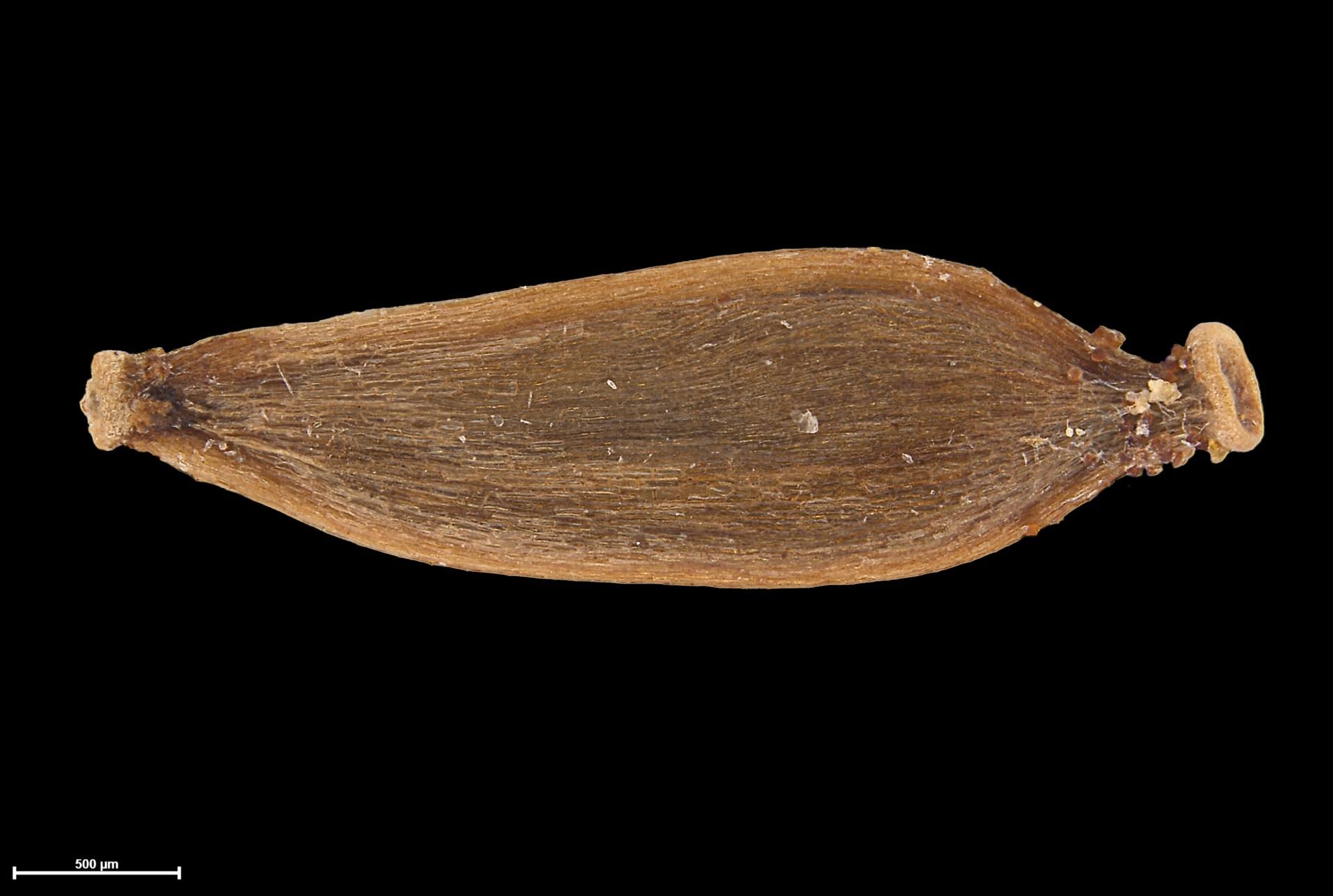
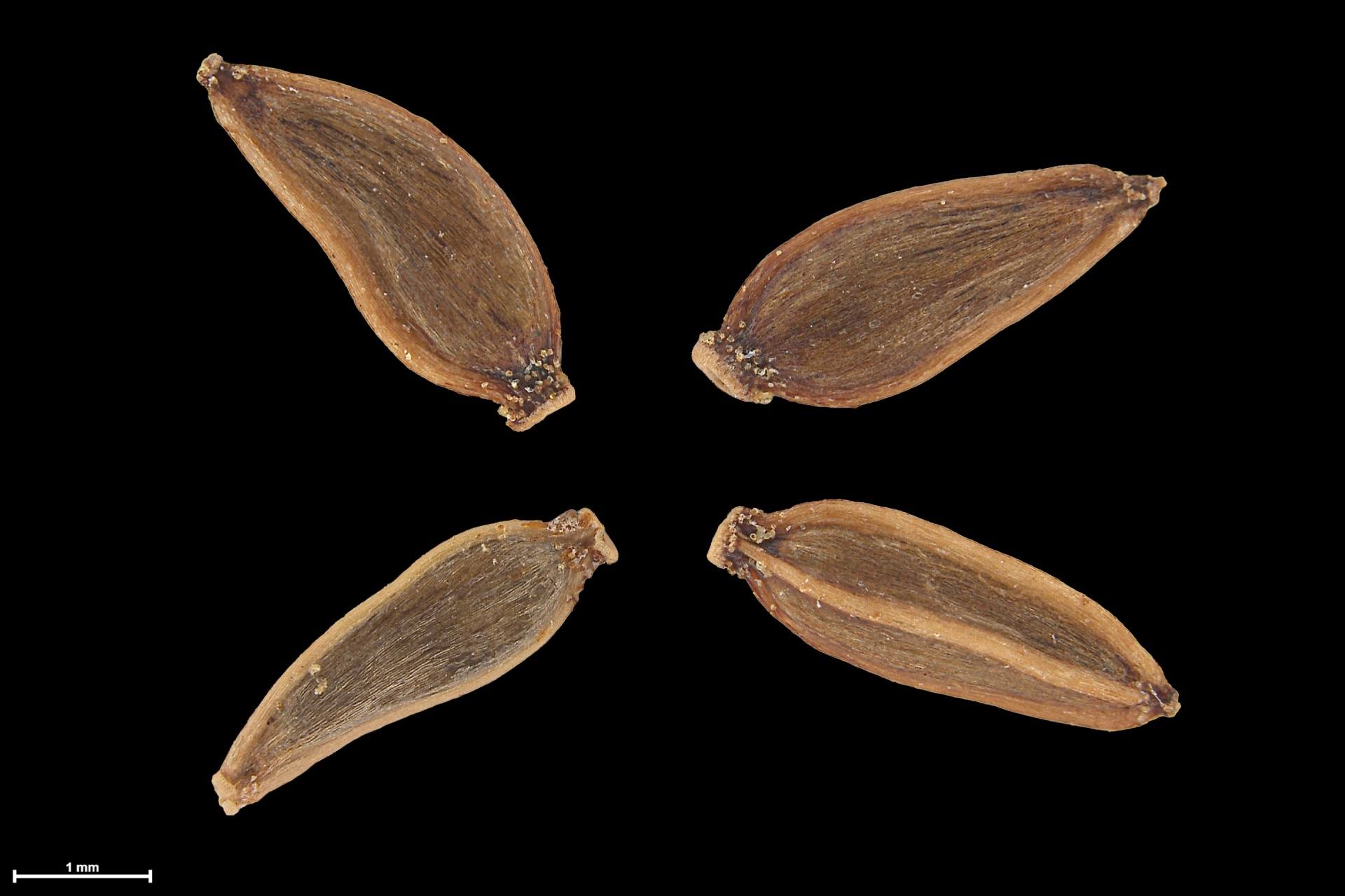
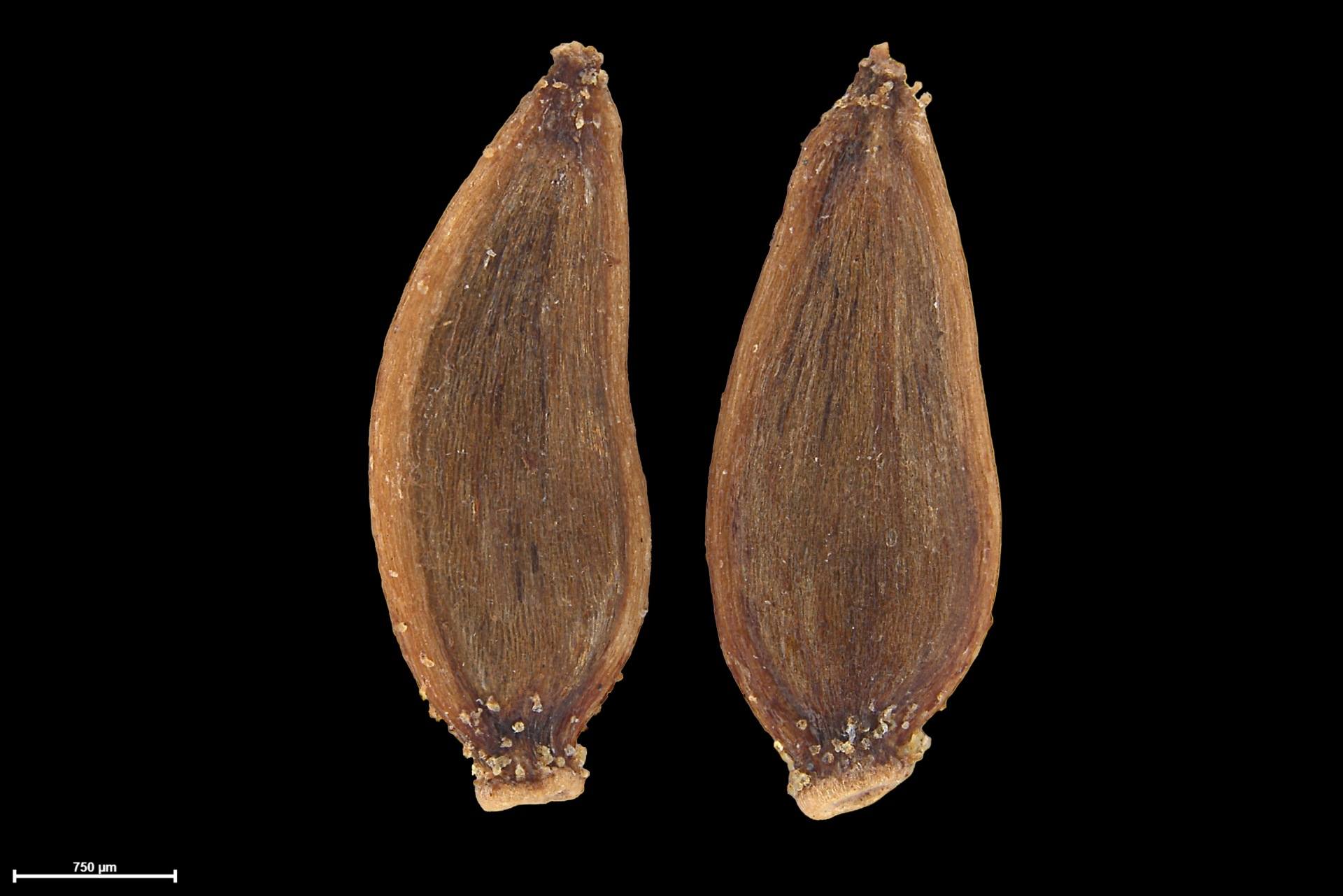
Helodeaster maviensis is a rhizomatous perennial herb, usually branched at the base. The stems are unbranched or branched at the base, with each branch having 1-5 lateral branches. Older stems become decumbent and usually produce adventitious roots. The leaves form a basal rosette or are distributed up to 16 cm along the ascending stem. They are spatulate, oblong, obovate to oblanceolate, measuring (1.5-)3-6.9 cm long and 0.4-1.3(-1.9) cm wide. The leaves are sessile and clasp the stem, with 1-13 bracts per scape that usually become progressively larger and more leaf-like toward the base. They are sparsely glandular-pubescent on the margins and veins, with the upper surface sometimes sparsely to moderately villous and the lower surface usually glabrous. The margins are coarsely serrate or sometimes dentate in the upper half, usually with five opposite pairs and one apical tooth, the teeth up to 2 mm long, sometimes purple at the tip. The heads are solitary, 8-19 mm in diameter, radiate, on scapes 3-30(-50) cm long, sparsely to moderately glandular, pubescent, and villous, especially at the base of the head, becoming glabrate with age. The involucral bracts are usually tinged purple at the apex, 4.5-8 mm long, sparsely to moderately glandular-pubescent, especially along the margins, which are fringed. Ray florets are conspicuous and pistillate, with rays that are white or green, sometimes tinged lavender or reddish purple, entire, 2-lobed, or merely notched at the apex, very rarely 3-lobed, (1.4-)2.5-3.9 mm long, sometimes with a few long hairs, and a purplish pistil. Disk florets are perfect, with yellow, peach-orange to purple corollas, 4-5-lobed, rarely 3-lobed, (2.4-)2.8-3.5 mm long, and purple filaments and anthers. The fruit is a simple, dry achene that is compressed, tapering to the apex, and usually conspicuously beaked, occasionally scarcely beaked, with a conspicuous cartilaginous ring at maturity, 2-4.5 mm long, with scattered, subsessile, globose glands at the apex and sometimes near the base. It occurs in bogs and montane wet forests between 915-1980 meters.
Bean-shaped (Reniform): Resembling the shape of a kidney or bean.
Square or Oblong: Angular shape with all sides more or less equal or longer than wide.
Triangular: Three-sided shape, broadest below the middle.
Elliptic: Rounded at both ends. shaped like an ellipse or oval.
Ovate or Obovate: egg-shaped, broader at one end.
Linear: Extremely long and narrow, with sides usually parallel.
Round: Appears circular, with length and width roughly the same.
Cardioid (Heart-Shaped): One edge has a prominent double curve into two lobes.
Cylindrical: A cylinder with parallel sides and a circular cross-section.
Discoid: Resembling a disc or plate with two relatively flat surfaces.
Fusiform: Spindle-shaped, tapering at both ends.
Globose: Spherical.
Lenticular: Resembling a lens with two convex surfaces.
Ovoid: Egg-shaped.
Plano-convex: Having a flat ventral (planar) surface and a curved dorsal (convex) surface.
Polygonal: Having more than three flat faces meeting at angles.
Sectoroid: Resembling a segment of an orange with two relatively flat faces and one curved face.
Subglobose/ellipsoid: Inflated shape but less than spherical.
Trigonous: Having three faces that meet at a distinct angle; triangular in cross-section.
Endangered species (E) are species that are so rare they’re in danger of becoming extinct.
Threatened species (T) are species that are likely to become endangered within the foreseeable future throughout all or a significant portion of their range.
Species of Concern (SOC) are species about which there are some concerns regarding status and threats, but insufficient information is available to list the species under the Endangered Species Act (ESA).
Plant Extinction Prevention (PEP) is a state status for rare plants that focuses its efforts on species that have fewer than 50 remaining wild individuals.
Orthodox seeds (desiccation-tolerant): can be dried to an internal seed moisture of less than 12% water and stored at freezing temperatures.
Intermediate seeds (temperature-sensitive) tend to age faster than orthodox seeds and may have only a 5-year lifespan when stored at -20°C. They are recommended for storage at 5°C.
Recalcitrant seeds (desiccation-sensitive): cannot be stored in a conventional freezer as they cannot survive after drying and/or freezing at -20°C. They are recommended for cryopreservation storage.